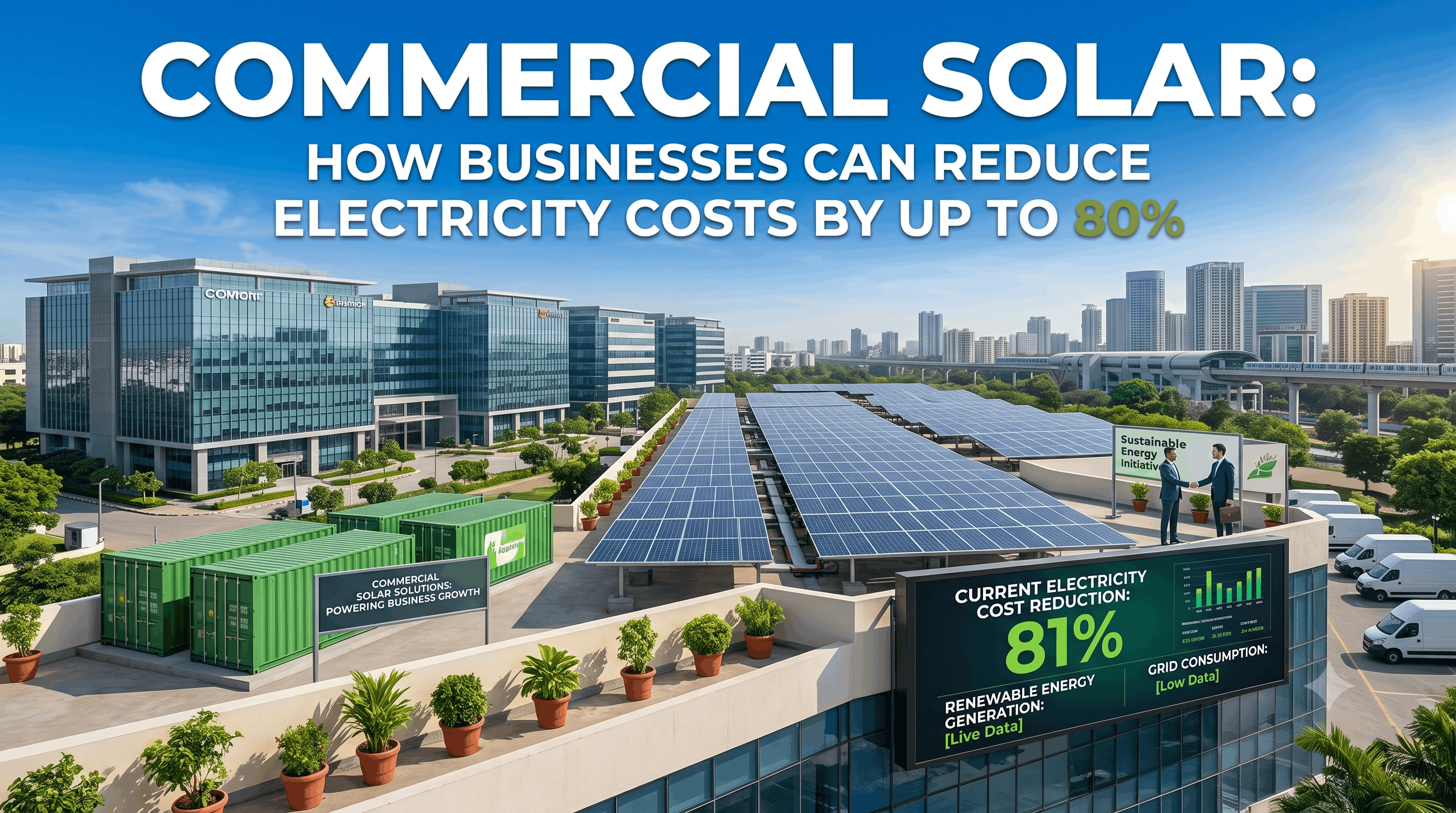
Commercial Solar: How Businesses Can Reduce Electricity Costs by Up to 80%
Electricity is one of the largest operating expenses for businesses across India. Whether it's a retail showroom, office building, hospital, hotel, educational institution, warehouse, or manufacturing facility, the cost of powering daily operations continues to rise every year.
As electricity tariffs continue to increase, more businesses are looking for sustainable ways to control operating costs. Commercial solar has emerged as one of the most effective long-term investments, allowing organizations to generate their own clean electricity while significantly reducing monthly bills.
From small retail stores to large corporate campuses, businesses across India are switching to rooftop solar because it delivers both financial and environmental benefits.
What Is Commercial Solar?
Commercial solar refers to photovoltaic (PV) systems installed on commercial properties to generate electricity for business operations. These systems are commonly installed on:
- Office buildings
- Shopping malls
- Retail stores
- Hotels & Resorts
- Schools & Colleges
- Hospitals
- Warehouses
- Corporate Campuses
- Cold Storage Facilities
Since commercial establishments consume most of their electricity during the daytime—the same time solar panels generate maximum power—they are among the biggest beneficiaries of rooftop solar.
Why Are Businesses Choosing Solar?
Electricity is a recurring expense that businesses cannot avoid. Every increase in utility tariffs directly impacts profitability. Solar allows businesses to generate a large portion of their own electricity, reducing dependence on the grid.
Some of the biggest advantages include:
- Lower monthly electricity bills
- Protection from rising electricity tariffs
- Excellent return on investment
- Reduced operating costs
- Improved sustainability goals
- Better brand image
How Does a Commercial Solar System Work?
Solar panels installed on the rooftop absorb sunlight and convert it into direct current (DC) electricity.
A solar inverter then converts DC into alternating current (AC), allowing the electricity to power office equipment, lighting, HVAC systems, computers, machinery, and other electrical appliances.
If the system generates more electricity than the business consumes, the excess power can often be exported back to the grid through net metering, depending on local regulations.
Benefits of Commercial Solar
Lower Electricity Bills
Businesses can reduce electricity expenses by 50%–80%, depending on system size and energy consumption.
Excellent Return on Investment
Most commercial solar projects recover their investment within 4–6 years, while the panels continue producing electricity for over 25 years.
Protection Against Future Tariff Hikes
Solar allows businesses to generate electricity at a predictable cost, reducing dependence on fluctuating utility prices.
Improved Sustainability
Companies using renewable energy demonstrate environmental responsibility, helping improve their ESG goals and brand reputation.
Types of Commercial Solar Systems
On-Grid Solar
- Connected to the utility grid
- Lower installation cost
- Supports net metering
- Higher ROI
Off-Grid Solar
- Battery-based system
- Ideal for remote locations
- Provides backup during outages
Hybrid Solar
Combines rooftop solar, battery storage, and grid connectivity, offering the flexibility of both backup power and net metering.
Recommended Roof Space
System Capacity Roof Area Required 10 kW 1,000 sq. ft. 20 kW 2,000 sq. ft. 50 kW 5,000 sq. ft. 100 kW 10,000 sq. ft.Things to Consider Before Installing Commercial Solar
- Analyze your annual electricity consumption.
- Evaluate rooftop strength and available space.
- Compare system quality instead of just pricing.
- Choose experienced installation partners.
- Understand local net metering policies.
Final Thoughts
Commercial solar is no longer just an environmental initiative. It is a smart business investment that helps reduce operating costs, improve sustainability, and generate long-term savings.
Whether you operate a retail outlet, hotel, hospital, warehouse, educational institution, or manufacturing facility, investing in commercial solar today can deliver reliable financial returns for decades to come.