Net Metering Explained: How It Helps You Save More with Rooftop Solar
One of the biggest concerns people have before installing a rooftop solar system is surprisingly simple: "What happens to the electricity I don't use?"
Imagine it's a bright afternoon. Your solar panels are generating plenty of electricity, but everyone's at work or school. The fans are off, the television isn't running, and only a few appliances are switched on. Your solar system is producing more electricity than your home is consuming.
Does that extra electricity go to waste?
Fortunately, it doesn't. This is where net metering comes into the picture.
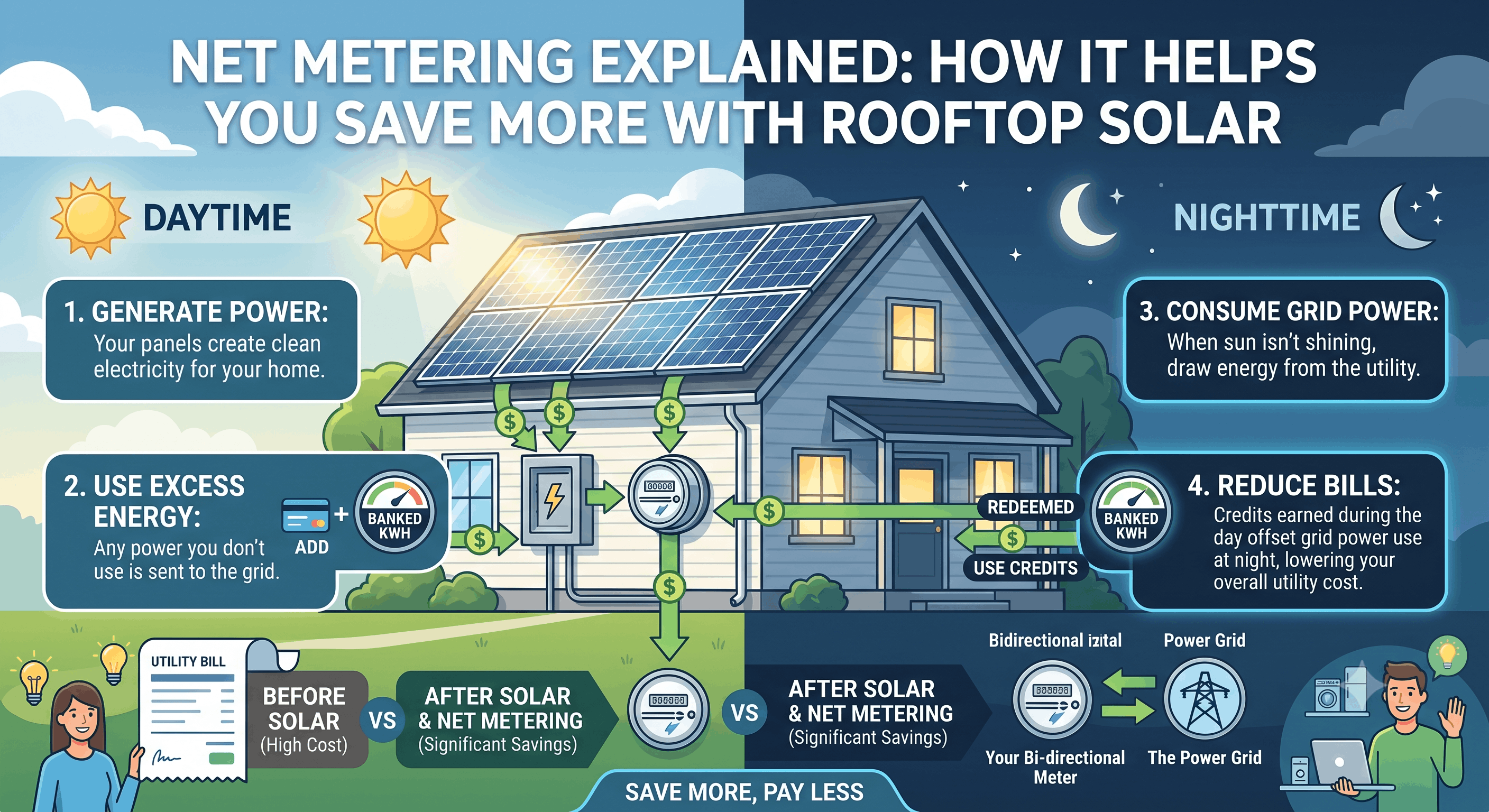
Net metering is one of the most valuable features of an on-grid solar system because it allows you to send excess electricity back to the power grid and receive credit for it. Your electricity meter records both the electricity you consume from the grid and the electricity your solar system exports.
For many homeowners and businesses, this feature makes rooftop solar far more economical than they initially expected.
Understanding Net Metering Without the Technical Jargon
Think of the electricity grid as a giant power bank.
During the day, when your solar system generates more electricity than you need, the excess power is exported to the grid. Instead of wasting that energy, your electricity distribution company records how much you've contributed.
Later, when your solar panels aren't producing electricity—such as after sunset or during cloudy weather—you draw electricity back from the grid.
At the end of the billing cycle, your electricity bill is calculated based on the difference between the electricity you've imported and the electricity you've exported.
That's why it's called net metering—you're billed only for the net amount of electricity consumed.
A Simple Example
Let's say your household uses 500 units of electricity in a month.
Your rooftop solar system generates 650 units during the same period.
- 500 units are used directly by your home.
- The remaining 150 units are exported to the electricity grid.
During cloudy days or at night, you import 120 units back from the grid.
Instead of paying for every unit consumed, your final electricity bill is adjusted based on the electricity exchanged with the grid.
The exact billing method depends on your state's electricity distribution company (DISCOM), but the basic principle remains the same.
Why Net Metering Makes Rooftop Solar More Valuable
Without net metering, any electricity generated beyond your immediate requirement would simply go unused.
Net metering ensures that excess electricity contributes toward reducing your electricity bill instead of being wasted.
For homeowners, this means greater monthly savings. For businesses operating during the day, it improves the return on investment from rooftop solar.
Instead of matching electricity consumption every minute of the day, the power grid effectively becomes a place where your surplus energy is stored through credits.
Do You Need a Battery If You Have Net Metering?
This is one of the most common questions people ask before installing solar.
In many situations, the answer is no.
If your area has reliable electricity and net metering is available, an on-grid solar system usually provides everything you need. During the day, your home uses solar electricity first, exports the excess, and then draws power from the grid after sunset.
Since the grid already acts as your backup, many homeowners avoid the additional cost of battery storage.
However, if your area experiences frequent power cuts or you require uninterrupted backup power, adding batteries may still be worthwhile.
Who Can Benefit from Net Metering?
Net metering isn't limited to individual homeowners.
It is commonly used by:
- Independent houses
- Housing societies
- Schools and colleges
- Office buildings
- Commercial establishments
- Hospitals
- Small and medium businesses
Any property with an eligible rooftop solar system and an approved electricity connection can generally apply, subject to local regulations.
Is Net Metering Available Everywhere?
Net metering policies are governed by individual states and implemented through their respective electricity distribution companies (DISCOMs).
While the overall concept remains the same, certain details may vary.
- Maximum system capacity allowed
- Eligibility criteria
- Billing methodology
- Application procedures
- Technical requirements
Since regulations can change over time, it's always advisable to check the latest guidelines before planning your installation.
How Do You Apply for Net Metering?
Although the exact process differs slightly between states, it generally includes the following steps:
- Install a rooftop solar system through an approved installer.
- Submit the application to your local electricity distribution company.
- Receive technical approval after inspection.
- Install a bi-directional (net) meter.
- Begin exporting and importing electricity through the grid.
Once approved, your rooftop solar system begins contributing towards reducing your monthly electricity bill.
Common Misconceptions About Net Metering
"My electricity meter simply runs backwards."
Modern digital meters separately record electricity imported from and exported to the grid instead of literally running backwards.
"Solar eliminates my electricity bill."
Not always. Your final bill depends on your electricity usage, solar generation, fixed charges, and your state's billing regulations.
"Net metering works during power cuts."
Most standard on-grid solar systems automatically shut down during grid outages for safety reasons. Unless your system includes battery backup or a hybrid inverter, it won't supply electricity during a blackout.
Tips Before Installing a Net-Metered Solar System
- Understand your average monthly electricity consumption.
- Ensure your rooftop receives sufficient sunlight.
- Avoid excessive shading from nearby buildings or trees.
- Choose an experienced installer familiar with local regulations.
- Focus on quality equipment instead of only comparing prices.
Proper system design and installation quality have a much greater impact on long-term performance than simply selecting the lowest quotation.
Is Net Metering Worth It?
For most homeowners and businesses, absolutely.
Net metering allows you to maximize the value of every unit of electricity your solar panels generate. Instead of worrying about using electricity immediately, you can rely on the grid to balance your energy usage throughout the billing cycle.
Combined with declining installation costs and supportive government initiatives, net metering has made rooftop solar one of the most financially attractive investments for residential and commercial properties.
Final Thoughts
Net metering is one of the key reasons rooftop solar has become so popular across India. It ensures that excess electricity generated by your solar panels doesn't go to waste and helps you maximize your return on investment.
While policies differ from state to state, the basic idea remains simple: generate electricity during the day, use what you need, export the rest to the grid, and receive credit for it.
If you're planning a rooftop solar installation, understanding net metering is just as important as selecting the right solar panels or inverter. A properly designed system with net metering can significantly reduce your electricity bills and shorten your payback period.