Solar Careers in India: Opportunities, Skills, Salaries & Future Growth
A decade ago, telling someone you wanted to build a career in solar energy might have earned you a puzzled look. Today, it's a completely different story.
India is one of the fastest-growing solar markets in the world. Every month, new residential projects, commercial rooftops, utility-scale solar parks, and industrial installations are being commissioned across the country.
Behind every successful installation is a team of professionals—engineers, designers, technicians, project managers, sales consultants, electricians, and many others.
The rapid growth of renewable energy has created thousands of jobs, and the demand for skilled professionals continues to rise. Whether you're a fresh graduate, a diploma holder, an electrician looking to upskill, or someone considering a career change, the solar industry offers opportunities across technical, managerial, and business roles.
If you're wondering whether solar is a good career choice, the short answer is yes. But like any profession, understanding the different roles, required skills, and growth opportunities is essential before taking the next step.
Why Is the Solar Industry Growing So Fast?
India's energy landscape is changing rapidly. With rising electricity demand, government support for renewable energy, and increasing awareness about sustainability, solar power has become one of the country's biggest growth sectors.
Several factors are driving this expansion:
- Growing residential rooftop solar installations
- Rising demand from commercial and industrial sectors
- Government schemes promoting renewable energy
- Falling costs of solar technology
- Expansion of utility-scale solar parks
- Increasing private sector investment
- Strong demand for skilled professionals
As more homes and businesses adopt solar, the need for trained professionals grows alongside it.
Is Solar a Good Career Option?
For many people, the first question isn't about the job itself—it's about the future.
"Will there still be demand 10 or 15 years from now?"
The answer looks promising.
Unlike industries that depend on short-term trends, renewable energy is becoming a core part of India's infrastructure. Every new solar project needs people to design it, install it, maintain it, inspect it, market it, and manage it.
As technology evolves, the types of jobs may change, but the demand for skilled professionals is expected to remain strong.
Career Opportunities in the Solar Industry
One of the biggest advantages of the solar sector is its diversity. It's not limited to engineers alone. Professionals from different educational backgrounds can find roles that match their skills.
1. Solar Design Engineer
Before a single panel is installed, someone has to design the system.
Solar design engineers analyze energy consumption, roof dimensions, shading, panel orientation, and structural feasibility before preparing detailed system layouts.
Typical responsibilities include:
- Designing rooftop solar systems
- Preparing electrical drawings
- Performing energy generation calculations
- Selecting suitable equipment
- Ensuring compliance with industry standards
This role is ideal for electrical, mechanical, and civil engineering graduates.
2. Solar Installation Engineer
Installation engineers supervise the actual implementation of solar projects.
Typical responsibilities include:
- Managing installation teams
- Coordinating with clients
- Inspecting equipment
- Ensuring quality standards
- Testing completed systems
Since every project is different, this role combines technical knowledge with problem-solving skills.
3. Solar Technician
Technicians are the backbone of the industry.
They handle:
- Panel installation
- Wiring
- Inverter connections
- Routine maintenance
- Troubleshooting
- Safety inspections
Diploma holders, ITI graduates, and electricians often pursue this career path.
4. Project Manager
Large commercial and industrial projects require careful planning.
Project managers coordinate every stage—from procurement and logistics to installation and commissioning.
Strong leadership and communication skills are just as important as technical knowledge in this role.
5. Sales & Business Development
Not every solar career involves climbing rooftops.
Companies also need professionals who can understand customer requirements, prepare quotations, explain return on investment, and build long-term relationships with clients.
Successful solar sales professionals combine technical understanding with excellent communication skills.
6. Operations & Maintenance (O&M)
Installing a solar plant is only the beginning. Operations and maintenance teams ensure systems continue performing efficiently throughout their lifespan.
Responsibilities include:
- Performance monitoring
- Preventive maintenance
- Cleaning schedules
- Fault detection
- Annual inspections
As India's installed solar capacity increases, O&M professionals are becoming increasingly valuable.
Skills That Can Give You an Edge
Technical knowledge is important, but employers often look beyond academic qualifications.
Technical Skills
- Electrical fundamentals
- Solar PV system design
- AutoCAD
- PVsyst software
- Single-line diagrams
- Site surveying
- Basic networking for monitoring systems
- Safety procedures
Soft Skills
- Communication
- Problem-solving
- Teamwork
- Time management
- Client interaction
- Project coordination
Professionals who combine technical expertise with strong interpersonal skills often progress faster into leadership positions.
Educational Backgrounds That Fit the Solar Industry
One of the best things about the renewable energy sector is that it welcomes professionals from different educational backgrounds.
You can build a career if you have qualifications such as:
- B.E./B.Tech (Electrical)
- Mechanical Engineering
- Civil Engineering
- Electronics Engineering
- Diploma Engineering
- ITI Electrician
- Renewable Energy courses
- MBA (Sales or Operations)
- Commerce graduates (for business roles)
Even candidates without engineering degrees can enter the industry through sales, marketing, procurement, administration, or customer support roles.
Salary Expectations
Like any industry, salaries depend on experience, skills, company size, and location.
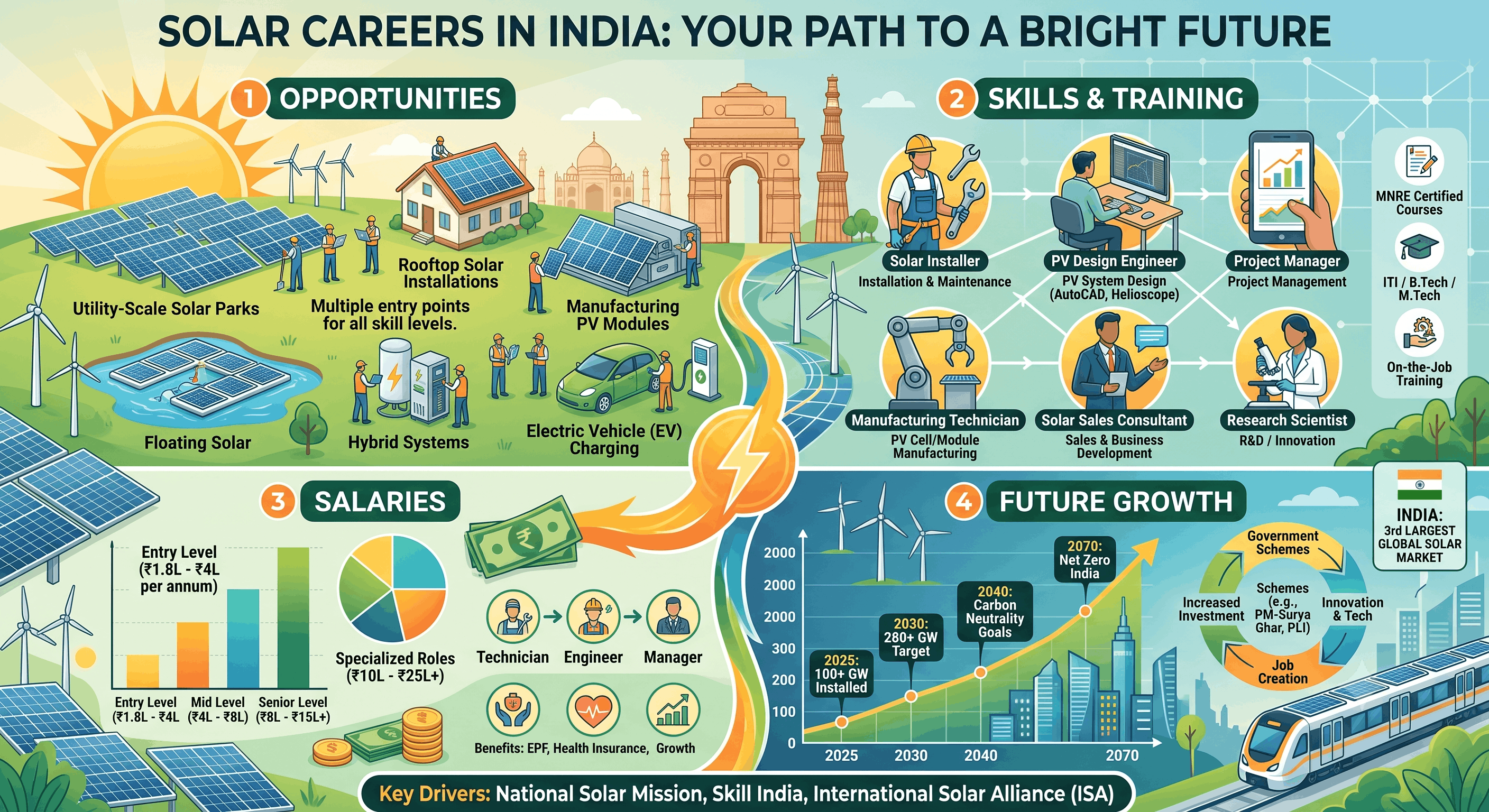
Experience Approximate Salary Range Fresher ₹2.5–4.5 LPA 2–5 Years ₹4–8 LPA 5–10 Years ₹8–15 LPA Senior Professionals ₹15 LPA and aboveProfessionals working on large industrial or utility-scale projects often earn significantly higher packages, especially in project management and technical consulting roles.
Certifications That Can Strengthen Your Resume
While not always mandatory, certifications can improve employability.
- Solar PV Design Courses
- Electrical Safety Training
- AutoCAD Certification
- PVsyst Training
- Project Management Certification
- Renewable Energy Certification Programs
Practical training often carries more weight than certificates alone, so look for programs that include hands-on experience.
Challenges of Working in the Solar Industry
Like every career, solar has its own challenges.
Field roles may involve:
- Outdoor work in different weather conditions
- Frequent travel to project sites
- Tight project deadlines
- Coordinating with multiple stakeholders
- Solving unexpected installation issues
However, many professionals enjoy the dynamic nature of the work, as every project presents a new learning opportunity.
Future Trends Creating New Career Opportunities
The solar industry isn't limited to installing panels anymore.
Emerging technologies are opening doors to new specializations, including:
- Battery energy storage systems
- Electric vehicle charging infrastructure
- Smart energy management
- AI-based energy monitoring
- Floating solar plants
- Agrivoltaics (solar integrated with agriculture)
- Green hydrogen projects
As these technologies mature, professionals with multidisciplinary skills will be in high demand.
Tips for Students and Fresh Graduates
If you're planning a career in solar, here's how you can get started:
- Learn the basics of electrical systems.
- Understand how solar PV systems work.
- Take a certified solar design course.
- Gain practical experience through internships.
- Learn AutoCAD and basic design software.
- Stay updated on renewable energy policies.
- Build a LinkedIn profile showcasing your projects and certifications.
- Don't hesitate to start with entry-level field experience—it provides valuable practical knowledge.
The industry values hands-on experience, so even small projects can make your resume stronger.
Final Thoughts
The solar industry is no longer a niche sector—it has become one of India's most promising career destinations. As the country continues investing in renewable energy, the demand for skilled professionals will only grow.
Whether your interests lie in engineering, design, project management, sales, maintenance, or business development, there's a place for you in this rapidly evolving industry.
More importantly, a career in solar offers something beyond financial growth. It gives professionals the opportunity to contribute to a cleaner, more sustainable future while working in an industry that's shaping the way India generates and consumes energy.
If you're looking for a field that combines technology, innovation, and long-term career stability, solar energy is certainly worth exploring.