
Solar Subsidies Explained: How Governments Are Powering the Shift to Clean Energy
Introduction
Solar panels may sit quietly on rooftops and in open fields, but behind their rapid rise is a web of government policy that has quietly shaped the entire industry. Subsidies, tax credits, rebates, and other financial incentives have played a crucial role in making solar energy affordable and accessible to millions of homeowners, businesses, and utilities around the world. Without this policy support in the early years, solar power might still be a fringe technology reserved for the wealthy or the especially committed environmentalist.
Understanding solar subsidies matters not just for policymakers and industry insiders, but for anyone considering installing solar panels or simply trying to understand why electricity markets look the way they do today. This post breaks down what solar subsidies are, why governments offer them, the different forms they take, and the debates surrounding their use.
What Are Solar Subsidies?
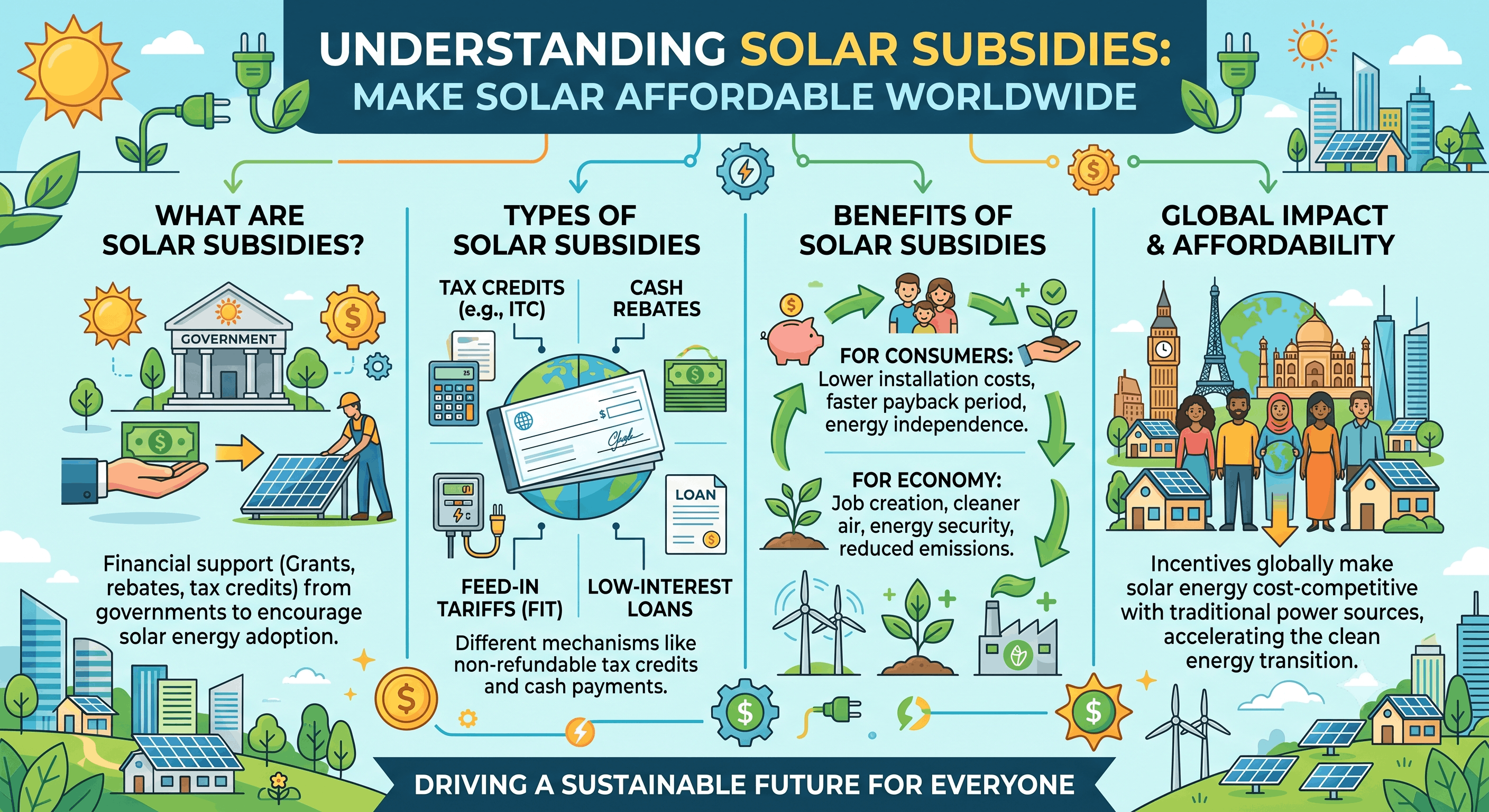
At its simplest, a subsidy is a form of financial support provided by a government to reduce the cost of a good or activity it wants to encourage. Solar subsidies specifically aim to lower the cost of purchasing, installing, or generating electricity from solar panels.
The reasoning behind these subsidies usually rests on a few pillars:
- Reducing greenhouse gas emissions
- Decreasing dependence on fossil fuel imports
- Creating jobs in a growing industry
- Helping an emerging technology reach the scale needed to become cost-competitive
Solar power, especially in its early days, faced what economists call a "chicken and egg" problem. The technology needed to be produced at scale to become affordable, but it needed to be affordable before widespread adoption could happen. Subsidies were designed to break this cycle by encouraging early adoption and accelerating technological improvements.
Types of Solar Subsidies
Solar subsidies come in many different forms, and most countries use a combination of these approaches.
Tax Credits
Tax credits allow homeowners or businesses to deduct a percentage of the cost of a solar installation directly from the taxes they owe.
Rebates
Rebates provide an immediate cash payment or discount at the time of purchasing or installing a solar system.
Feed-in Tariffs
Feed-in tariffs guarantee payments for electricity generated by solar systems and exported back to the power grid.
Net Metering
Net metering allows solar owners to receive credits for excess electricity sent to the grid, reducing future electricity bills.
Grants & Low-Interest Financing
Governments often offer grants, subsidized loans, or low-interest financing to reduce the upfront cost of installing solar systems.
Accelerated Depreciation
Businesses can recover their investment faster by claiming depreciation benefits on solar assets over a shorter period.
Why Governments Offer These Incentives
Governments encourage solar adoption because renewable energy helps reduce pollution, lower greenhouse gas emissions, improve energy security, and reduce dependence on imported fossil fuels.
Solar subsidies also support domestic manufacturing, encourage investment, and create employment opportunities across manufacturing, installation, maintenance, and research.
Many governments introduced subsidies as temporary support until solar technology became competitive enough to stand on its own.
The Debate Over Solar Subsidies
Solar subsidies remain a topic of debate among economists, policymakers, utilities, and industry experts.
Supporters Believe:
- Subsidies accelerated solar adoption.
- They reduced emissions and electricity costs.
- They encouraged technological innovation.
- They helped build a competitive renewable energy industry.
Critics Argue:
- Subsidies can distort markets.
- Benefits may favor wealthier households.
- Net metering may shift grid costs to non-solar users.
- Long-term subsidies may no longer be necessary in mature markets.
How Solar Subsidies Vary Around the World
Solar incentive programs differ significantly between countries.
The United States primarily relies on tax credits and state-level incentives. China has invested heavily in manufacturing support and feed-in tariffs. European countries pioneered feed-in tariff programs before moving toward competitive auctions.
Many developing nations combine grants, climate finance, and domestic incentive programs to expand access to solar energy, particularly in rural communities.
Looking Ahead
As solar technology becomes more affordable, government policies are gradually shifting toward supporting battery storage, smart grids, domestic manufacturing, and grid modernization rather than simply subsidizing panel installations.
Future incentives may increasingly reward actual electricity generation instead of installation alone, ensuring better long-term performance from solar investments.
Conclusion
Solar subsidies have played a major role in transforming solar energy from an expensive niche technology into one of the world's most affordable electricity sources.
Through tax credits, rebates, feed-in tariffs, net metering, and financing programs, governments have helped millions of homeowners and businesses transition to clean energy.
While discussions about the future of subsidies continue, their contribution to the growth of renewable energy is undeniable. As technology advances and policies evolve, solar subsidies will continue influencing how countries build cleaner, more sustainable energy systems.