Why Manufacturing Industries Are Rapidly Switching to Solar Power
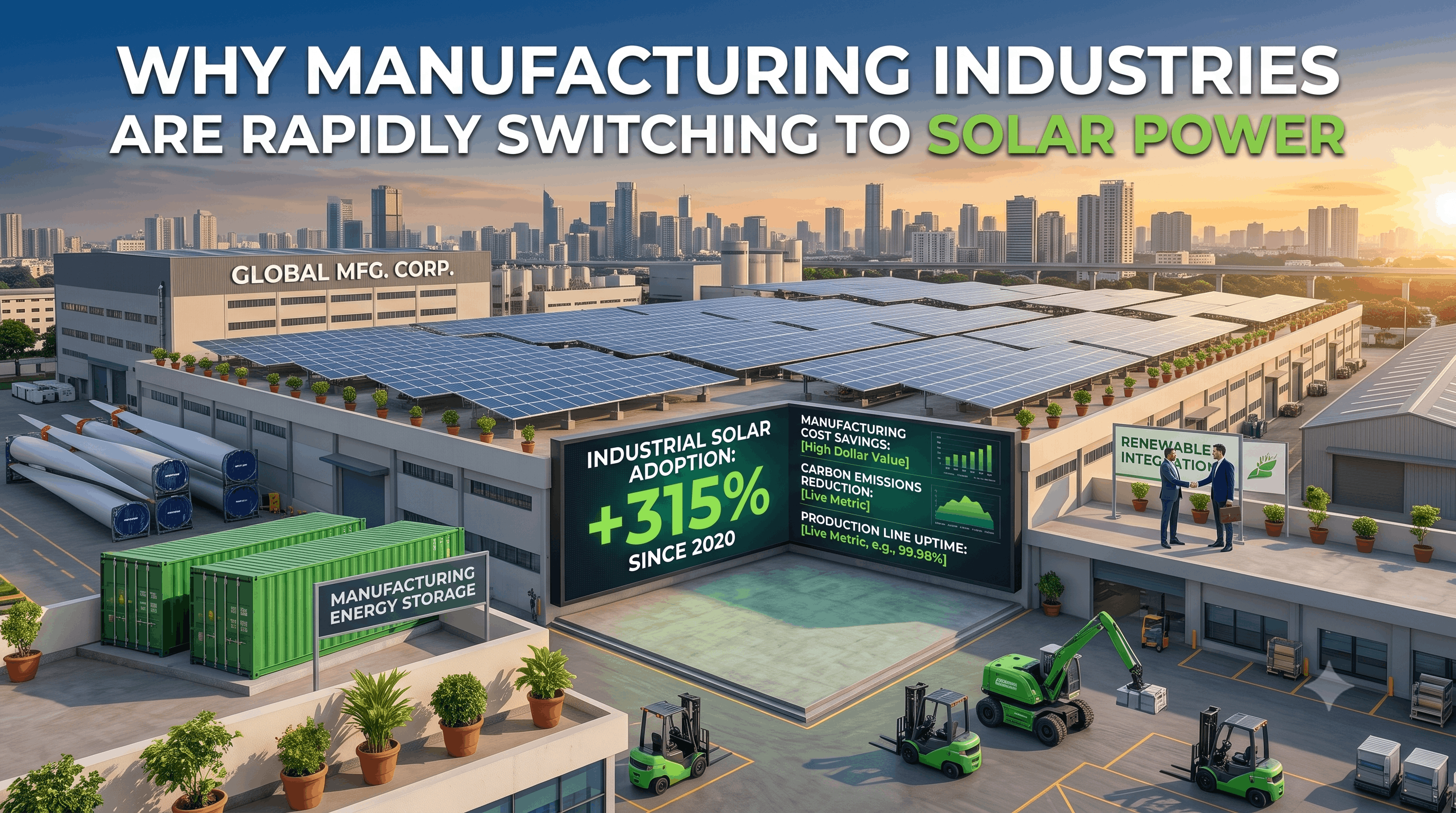
Walk through any industrial estate in Pune, Ahmedabad, Hosur, Sanand, or Bhiwadi today, and you'll notice something that has quietly become the new normal. Factory rooftops that once sat unused are now covered with rows of solar panels.
A decade ago, installing solar was often seen as a sustainability initiative. Today, the conversation has changed completely. Factory owners aren't asking whether solar is good for the environment—they're asking how quickly it can reduce their electricity bills.
Manufacturing has become increasingly expensive. Raw material prices fluctuate, fuel costs are unpredictable, labour expenses continue to rise, and electricity remains one of the largest fixed costs for almost every industry. Solar offers manufacturers something they've rarely had before—control over one of their biggest recurring expenses.
Electricity Costs Are Eating Into Industrial Profits
Whether it's an automobile plant, textile mill, pharmaceutical unit, food processing facility, engineering workshop, or packaging company, electricity is essential to daily operations.
Compressors, CNC machines, conveyors, motors, cooling systems, boilers, HVAC equipment, and lighting contribute to enormous energy consumption. Even a small increase in electricity tariffs directly affects production costs and profit margins.
"For most manufacturing businesses, electricity isn't just another expense—it's one of the biggest factors that determines profitability."
That's exactly why many industries have started investing in renewable energy—not because they were forced to, but because it makes financial sense.
Why Solar Makes Perfect Sense for Factories
One of the biggest advantages of industrial solar is that factories consume most of their electricity during the same hours that solar panels generate maximum power.
Unlike residential homes where electricity demand usually peaks during the evening, manufacturing facilities operate throughout the day. This allows factories to consume a significant portion of the electricity they generate without depending heavily on battery storage.
The result is a faster return on investment and significantly lower monthly electricity bills.
It's No Longer Just About Sustainability
There was a time when renewable energy was mainly associated with environmental responsibility. While sustainability remains important, economics has become the primary reason industries are adopting solar.
Imagine a factory spending ₹40 lakh every year on electricity. If a rooftop solar system reduces that expense by just 60%, the annual savings exceed ₹20 lakh.
Over the lifetime of the system, those savings can amount to several crores—money that can be invested in expanding production, upgrading machinery, hiring skilled employees, or improving infrastructure.
How Does an Industrial Solar System Work?
Industrial solar systems work on the same principle as residential rooftop systems, but on a much larger scale.
- Solar panels absorb sunlight.
- They generate DC electricity.
- Industrial inverters convert it into AC electricity.
- The factory consumes solar power first.
- Additional electricity is drawn from the grid whenever required.
In states where net metering is available, excess electricity can also be exported back to the utility grid.
From Empty Rooftops to Revenue-Generating Assets
Most factories already possess one valuable resource—large rooftops.
Industrial sheds covering thousands of square metres can now generate electricity every day for over 25 years instead of remaining unused.
Even industries without sufficient roof space can install ground-mounted systems or choose captive solar plants and open-access solar solutions.
Industries That Benefit the Most
While almost every manufacturing business can benefit from solar energy, certain industries experience particularly impressive returns.
- Textile Manufacturing
- Food Processing Units
- Automobile Manufacturing
- Pharmaceutical Companies
- Engineering & Fabrication Workshops
- Chemical Industries
- Cold Storage Facilities
Since these industries consume large amounts of electricity throughout the day, they are perfectly suited for industrial solar installations.
Return on Investment
One of the first questions every business owner asks is:
"How long will it take to recover my investment?"
While the answer depends on electricity tariffs, system size, and energy consumption, most industrial solar projects recover their investment within 4–6 years.
Factor Typical Value Payback Period 4–6 Years Solar Panel Life 25+ Years Potential Savings 40–80%Maintenance Is Easier Than You Think
Many business owners assume that maintaining a large solar plant is difficult. In reality, modern solar systems require surprisingly little maintenance.
Cleaning the panels periodically, inspecting electrical connections, and servicing the inverter when required is usually sufficient to keep the system performing efficiently.
Most installations also include remote monitoring software, allowing facility managers to track electricity generation from a computer or smartphone.
Solar Can Also Help You Win More Business
International buyers increasingly evaluate suppliers based on their sustainability practices.
Manufacturers using renewable energy often strengthen their reputation while meeting ESG goals and improving their chances of winning contracts from global companies.
In other words, solar doesn't just reduce operating costs—it can also become a competitive advantage.
Choosing the Right Installation Partner
Installing solar isn't simply about buying panels.
Engineering quality, structural design, inverter selection, cable management, and installation practices all influence the system's long-term performance.
Before making an investment, manufacturers should compare more than just price.
- Experience with industrial projects
- Quality of equipment
- Performance warranties
- After-sales support
- Maintenance services
The Future of Industrial Solar
India's manufacturing sector is expanding rapidly, and electricity demand will continue growing alongside it.
Advancements in smart monitoring systems, high-efficiency solar panels, AI-based energy management, and battery storage are making industrial solar more efficient and affordable than ever before.
Businesses that invest today are positioning themselves for lower operating costs and stronger competitiveness over the next two decades.
Final Thoughts
Industrial solar has evolved from being a sustainability initiative into a practical business strategy.
Every unit of electricity generated from the sun is one less unit purchased from the grid. Over time, those savings translate into improved profitability without affecting production capacity.
For manufacturers, the technology has already proven itself. The real question is no longer whether solar works—it's whether delaying the investment makes financial sense.